
Giotto Riva
Giotto Riva
Marginalia
Curated by Ivan Quaroni
Solo Private Corporate Show for Viatris Group
Sponsored by Fondazione Maimeri
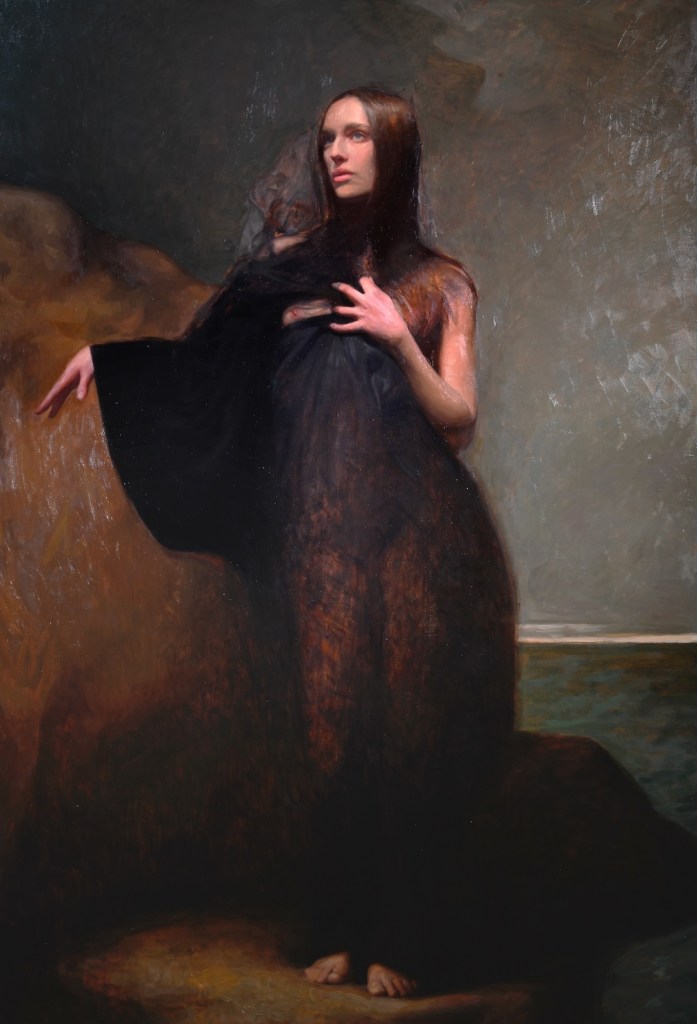
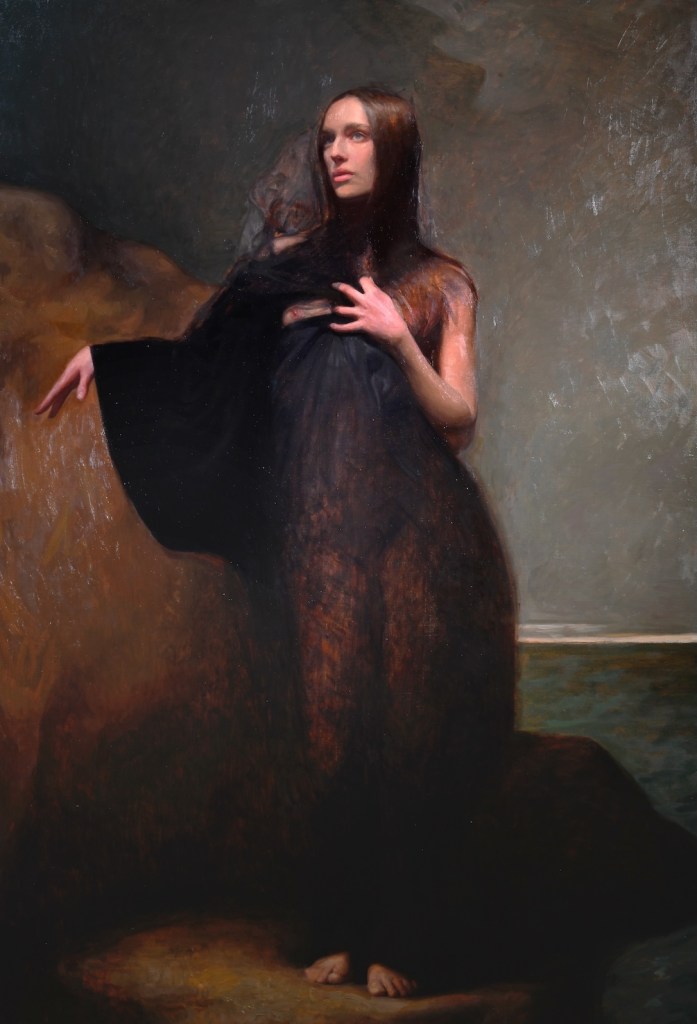
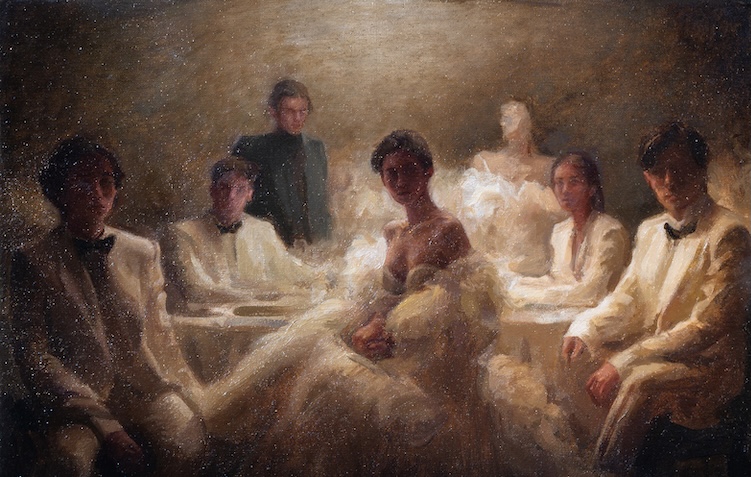
La Notte / oil on canvas – 100 x 150 cm / 2026
by Ivan Quaroni
‘Marginalia’
Giotto Riva’s painting is the result of a deliberate choice, the adoption of figuration as a privileged language to narrate the present and to represent realities that other expressive modes overlook, such as, for example, the emotional sphere of individuals. It is a clear choice that allows the artist to grasp aspects that form the subtle fabric of everyday life, a barely visible layer behind the surface of things. But capturing these aspects through painting requires discipline, rigor, constant practice and a careful attention to the most subtle inflections of experience. In this sense, the period that Giotto Riva spent in Barcelona takes on essential importance. His training at the Barcelona Academy of Art, which is a school strongly oriented toward realism, led under the guidance of Jordi Díaz Alamà, allowed him to develop, through progressive exercises, plaster casts, portraits from life and preparatory work based on monochrome painting, an extremely rigorous working method. The teaching he received focused, above all, on the central role of light and on the precise measurement of tonal relationships. This discipline deeply shaped Giotto Riva’s practice, who built a grammar based on nineteenth-century technique, a preparation founded on a slow and measured construction of the work. The study of drawing, formal structure and masses of light are part of a language that, however, the artist has been able to express through a fresh and spontaneous gesture. Although his works are rigorously composed through a large number of preparatory studies, sketches and grisaille paintings that guide the later color layers and although the work matures through a gradual and thoughtful process, the final surface always appears vivid, intense, not without a certain happy immediacy.
Giotto Riva, in fact, gives decisive value to sincerity and considers painting as an act that involves the artist’s personal exposure, a public revelation of his sensitivity, of his inner world. The artist often adapts to painting the expression attributed to Ernest Hemingway “to sit at the typewriter and bleed”1, to suggest that painting means allowing the most fragile part of one’s personality to emerge..
There is, in this attitude, an almost psychoanalytic tension, a desire for self-examination understood as listening to the emotional currents that come before the gesture.
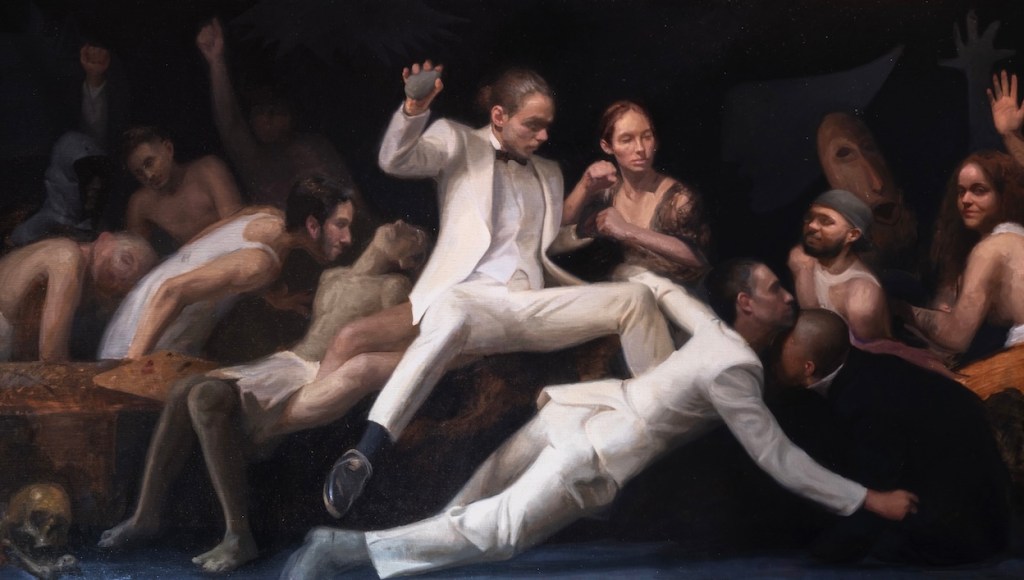
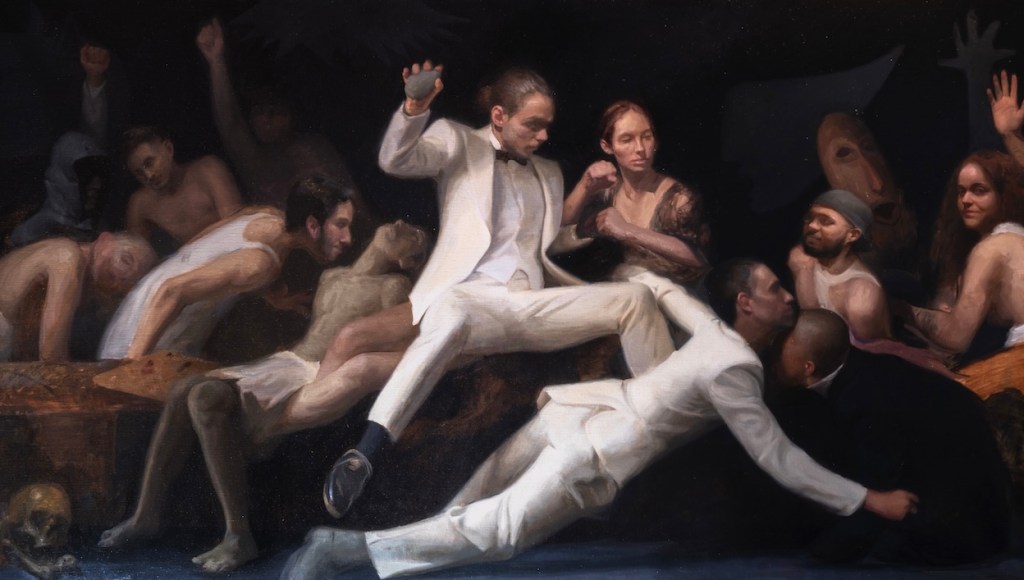
Il Conflitto / Oil on Canvas – 90 x 150 cm / 2025
Giotto Riva listens to these vibrations and translates them into the atmospheric modulations of his painting, skillfully weaving together different shades of mood with the intermittent flashes of memory.
The cultural references evoked by the artist outline a genealogy that is linguistically varied, but conceptually coherent. Late nineteenth-century European Realism directs attention toward the artist’s interest in everyday life, for example, the Post-Impressionist tradition, from Paul Cézanne to Édouard Vuillard, gives a luminous mark, able to shape the scenes of his paintings in delicate tones. From the Scapigliatura and from artists such as Tranquillo Cremona and Daniele Ranzoni comes perhaps the more restless side of
Riva’s style, the one inclined toward the representation of fleeting and transitory states. His passion for the Poètes maudits suggests, instead, a vocation for the darker side, for shadowed areas and marginal lives. Riva recognizes, in fact, the essential legacy of a certain French tradition, the one that goes from Charles Bargue to Jean-Léon Gérôme to John Singer Sargent, as well as of the Spanish figurative painting derived from Joaquín Sorolla, a true luminous source. According to the artist, in fact, there exists an “emotional thread” able to cross different eras and reappear in the form of intuition, a kind of hidden link that nourishes his painting practice. His production develops through a balanced combination of technical rigor and sensitive attitude in which figuration plays an essential role. According to his vision, a work should always create an immediate understanding and make it easier for the public to approach the artistic experience. The human figure is often central in his painting, precisely because it is able to transmit an emotional quality that goes beyond the single representation. For Riva, in fact, every image has a sort of emotional resonance that can be expressed through the basic elements of painting: light, gesture, color and form. Photography is an element that naturally accompanies his creative process. The initial photographic images, however, are filtered through sketches and preparatory studies that come before the execution of the painting. In this way his paintings take shape through a slow progression, until they reach the right level of emotional density.
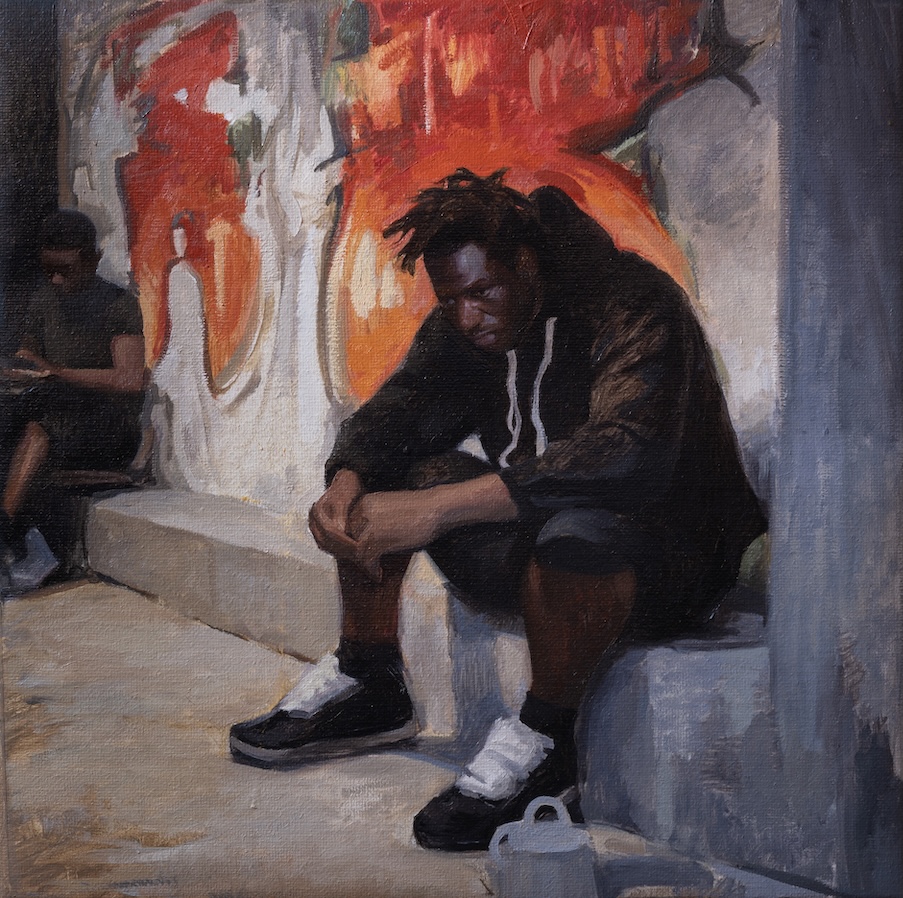
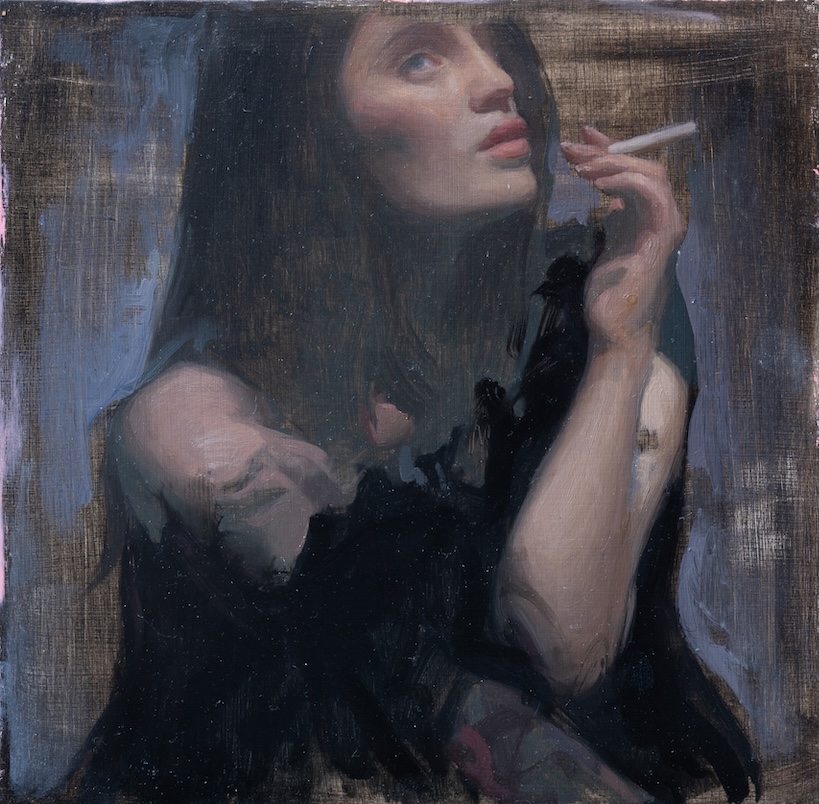
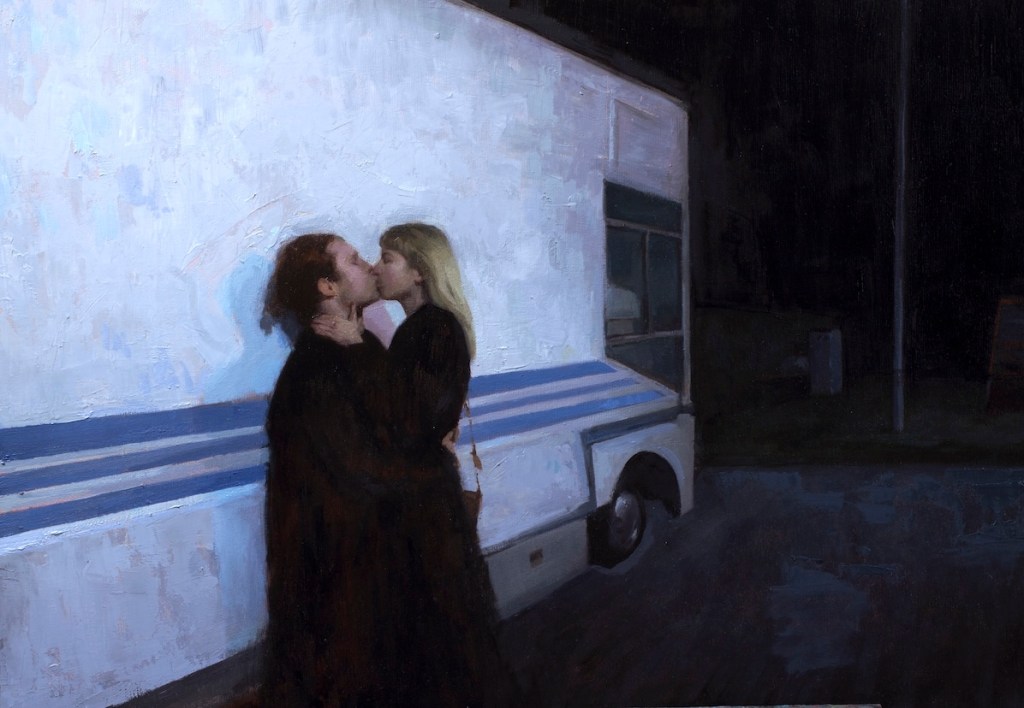
La Strada / Oil on canvas – 55 x 55 cm / 2023
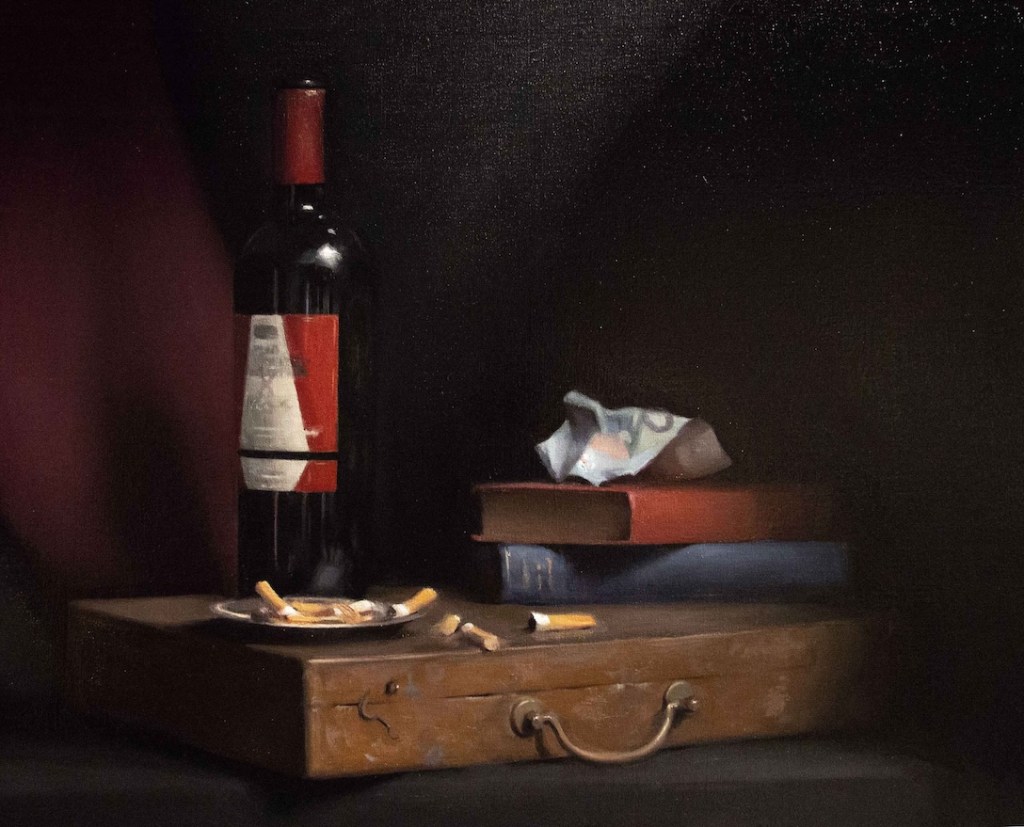
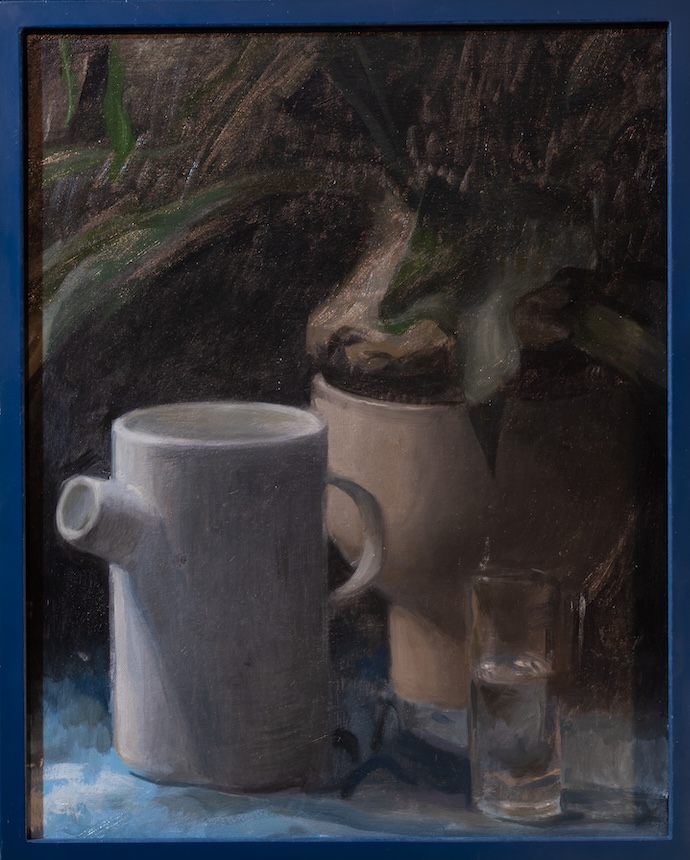
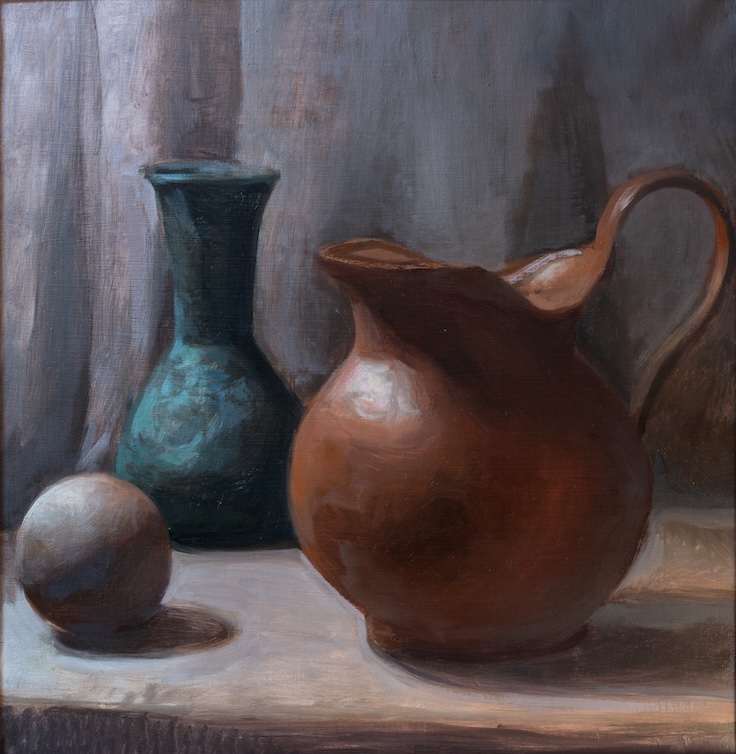
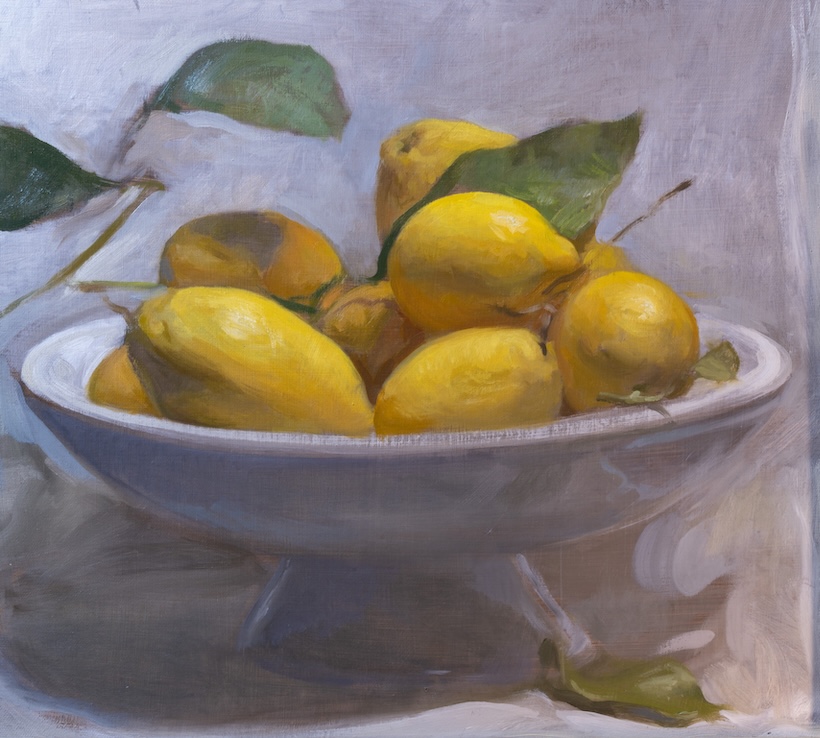
In his works it is often the presence of marginal elements and secondary details that opens the perceptual field and introduces everyday life into the scene. It is a tendency that clearly emerges especially in the still lifes that capture small details of the most ordinary dimension of existence. Works such as Still Alive (2019), Natura morta con caraffe (2025), Natura morta con bicchier d’acqua (2025) and Natura morta I limoni (2025) show a trained attention in observing objects shaped by repeated gestures and daily habits.
Giotto Riva is a painter interested in matter, able to build, through textures, volumes, cuts of light, a narrative that goes beyond what is strictly represented on the canvas. Not only does material density give weight to the depicted objects, but it transforms them into entities with a silent power. To this line belong, for example, paintings such as Dessert (2025) and Spicy Nights (2023) that capture in close up details of an almost cinematic sequence, which opens to multiple interpretative possibilities.
The urban scenes follow the same line, they seem fragments of a story whose plot we are asked to reconstruct. La strada (2023) and Il bacio (2020) suspend the narration in an undefined time. They look like frames from a film to which painting, however, gives a stronger vitality. The artist’s interest in the emotional quality of the instant can be seen in the way he renders the subtle vibrations of the protagonists’ state of mind. The same can be said of El Jaleo (2023), where the echo of Iberian tradition filters through a luminosity that comes from quick and lively gestures, which dynamically animate the figure.
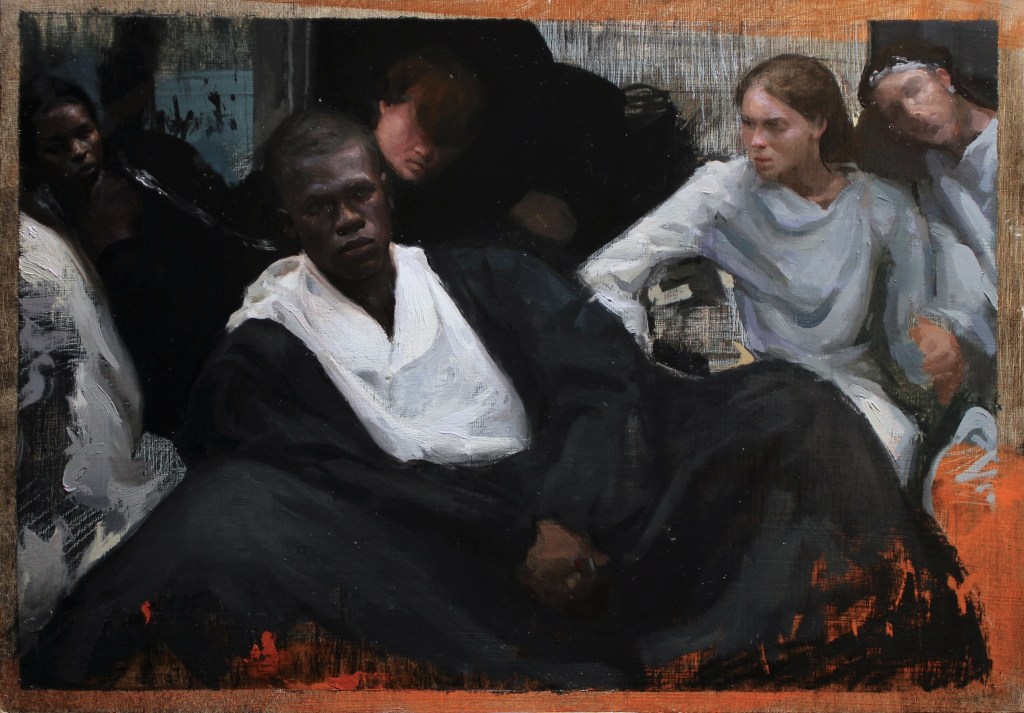
Indulgence / Oil on board – 20 x 30 cm / 2024
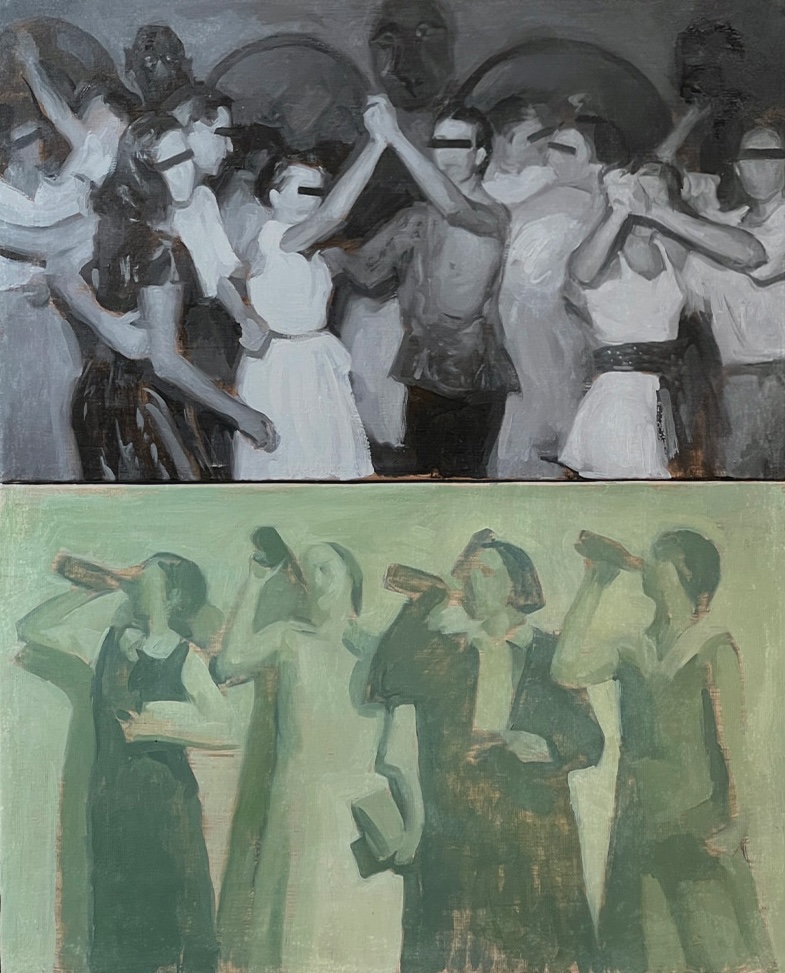
A different structure of the image appears in Com’era bello ballare (2025), a work with a postmodern flavor that organizes the scene on two distinct levels. The upper area, set in a milky range of greys, seems to emerge from a distant and removed memory (the characters all have a censor bar over their eyes to hide their identity), while the lower part reworks a similar scene with a slower rhythm, modulated in a greenish tone that gives a more relaxed atmosphere. The two parts create an uneven rhythm that emphasizes the complex temporal structure of the narration.
The larger compositions further expand this research. A collective work such as Il Conflitto (2025) organizes the image like an organism crossed by simultaneous currents. The masses of bodies, caught in the almost orgiastic frenzy of a fight, draw internal directions that light organizes into an ordered geometric diagram with a Renaissance flavor. Among the collective paintings there is, paradoxically, also the small canvas Indulgenze (2025), where Riva creates a less explosive composition, favoring an expressive register made of composed and restrained gestures..
In the large painting entitled La Notte (2025), the protagonist is the female personification of darkness, shaped according to the canons of Symbolist and Decadent painting in the form of an ideal femme fatale. One may think of Arnold Böcklin, Puvis de Chavannes, but also of our Aristide Sartorio, the one closer to D’Annunzio. Alongside these works the Dittico del Pianto (2025) introduces a more intimate register, in which painting unfolds through emotional fragments, lyrical shards emerging from distant memories.
For Giotto Riva painting is above all a cognitive instrument able to bring experience back to the center of the image. His images organize lyrical impulses and emotional drives according to a sensitive logic, making them vibrate even in the smallest details in order to create a deep emotional resonance in the viewer. A painting that is able to do this is not only capable of reconnecting with its original dimension, but also of rediscovering its ontological foundation. Which is ultimately that of going beyond ordinary experience, offering itself as an unavoidable residue that restores to life its most secret part, transforming it into a lasting trace that continues to operate beneath the threshold of our consciousness..

Credits
- Author: Ivan Quaroni
- Paintings: Giotto Riva
- Host: Viatris Group
- Event: Rassegna Culturale ViviLarte
- Sponsored by: Fondazione Maimeri
 Giotto Riva